
Rory McIlroy creating a Masters Champions Dinner menu seemed inevitable when he burst onto the scene nearly 20 years ago. However, none of us, especially the uber-confident McIlroy, would have ever imagined it would take him 16 tries to win the Masters and earn the right to wow us all with his celebratory menu.
Well, he won, and now we get to compare his menu to those of his peer champions and break down what he’s serving and even why he’s serving it.
What he’s crafted somehow manages to be what you’d mostly expect, with a touch of culinary flair. It’s refined without feeling pretentious, indulgent without going over the top, and—most importantly—something the average American diner would actually be excited to eat or, at the very least, give a try like Guy Fieri would do at the nicest DDD in the world.
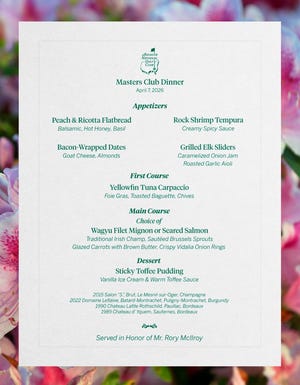
Let’s start with the opening act. McIlroy rolls out a greatest-hits platter of appetizers: bacon-wrapped dates stuffed with goat cheese, crispy rock shrimp tempura, a peach and ricotta flatbread with hot honey (we’d start here!), and grilled elk sliders (put us down for a small taste before we take a big gamey bite). This is a power move. There’s something for everyone here. The bacon-wrapped dates hit that sweet-salty comfort zone, the shrimp bring the crunch, and the flatbread sneaks in a trendy restaurant vibe. Even the elk sliders—arguably the wild card—feel approachable. They’re still sliders, after all. It’s not like he’s asking anyone to wrestle a deer, or Great White, before dinner.
Then comes the first course: yellowfin tuna carpaccio with foie gras and baguette. This is where things get a little fancy—but not in a scary way. Think of it less as “intimidating fine dining” and more as “surf and turf that went to a private school.” The tuna is light and delicate, the foie gras is rich and buttery, and the baguette keeps everything grounded. For diners who might side-eye foie gras on a menu, this is about as friendly an introduction as you’re going to get. Let’s also keep in mind that if any of the guys wearing a green blazer truly had a foie gras psycho-allergy, I’m sure the chef would serve them up a plate sans the duck liver.
For the main course, McIlroy wisely doesn’t overthink it. You get a choice: Wagyu filet mignon or seared salmon. Translation: you’re either having one of the best steaks of your life or a perfectly cooked piece of fish that still feels like a treat. The sides—Irish champ, Brussels sprouts, glazed carrots, and onion rings—are where the charm really kicks in. Onion rings at a Champions Dinner? Absolutely. It’s like Augusta National briefly said, “You know what, let’s have some fun tonight.” The whole selection reads like a luxury steakhouse greatest-hits album, and that’s a compliment. Heck, maybe McIlroy’s side choices are even a nod to his idol and TGL business partner, Tiger Woods’ menus that always were more laid back than upper crust.
Dessert seals the deal with sticky toffee pudding, which is basically a warm hug in dessert form. It’s rich, comforting, and just indulgent enough to make you forget how full you are. Even the person who said, “I’m skipping dessert tonight” will suddenly find themselves holding a spoon.
Now, let’s talk about the part of this dinner that quietly turns it from “wow, that’s nice” to “wait, how much is this?”—the wine. McIlroy didn’t just pick good bottles; he picked legendary ones. We’re talking 2015 Salon Champagne, 2022 Domaine Leflaive Bâtard-Montrachet, 1990 Château Lafite Rothschild, and 1989 Château d’Yquem. In a Michelin-star restaurant in New York City, this isn’t your standard wine pairing—it’s the kind of list that makes sommeliers grin and accountants nervous.
A single glass of the Lafite alone could run $600 to $800. The white Burgundy and Champagne aren’t far behind, and the Yquem—often called “liquid gold”—adds another luxurious exclamation point. All in, the wine pairing would likely land somewhere between $1,200 and $1,600 per person.
Add in the food, which would realistically cost $500 at a top-tier restaurant, and you’re looking at a total experience in the neighborhood of $1,700 to $2,000+ per guest, pre tax and gratuity. In other words, this is not your typical dinner reservation, even at ANGA. Nor should it ever be.
What makes McIlroy’s menu so great, though, isn’t just the price tag or the prestige — it’s the balance. This is a meal that feels special without trying too hard. It’s elevated, but still familiar. It’s the kind of dinner where a die-hard foodie and someone who just loves a good steak would both walk away happy.
And really, that might be the most impressive part of all. Rory didn’t just win the Masters—he created a menu that the men he has always admired and wanted to dine with during Masters week on Tuesday would enjoy just as much as he did.